Apple opened iPhone Duo preorders on 16 October, and the first foldable iPhone ships on 23 October from $1,999.
The short answer: buy it if you want a foldable. Do not buy it as a camera or battery upgrade. On both counts the $1,299 iPhone 18 Pro Max beats it, and by more than the $700 price gap would suggest.
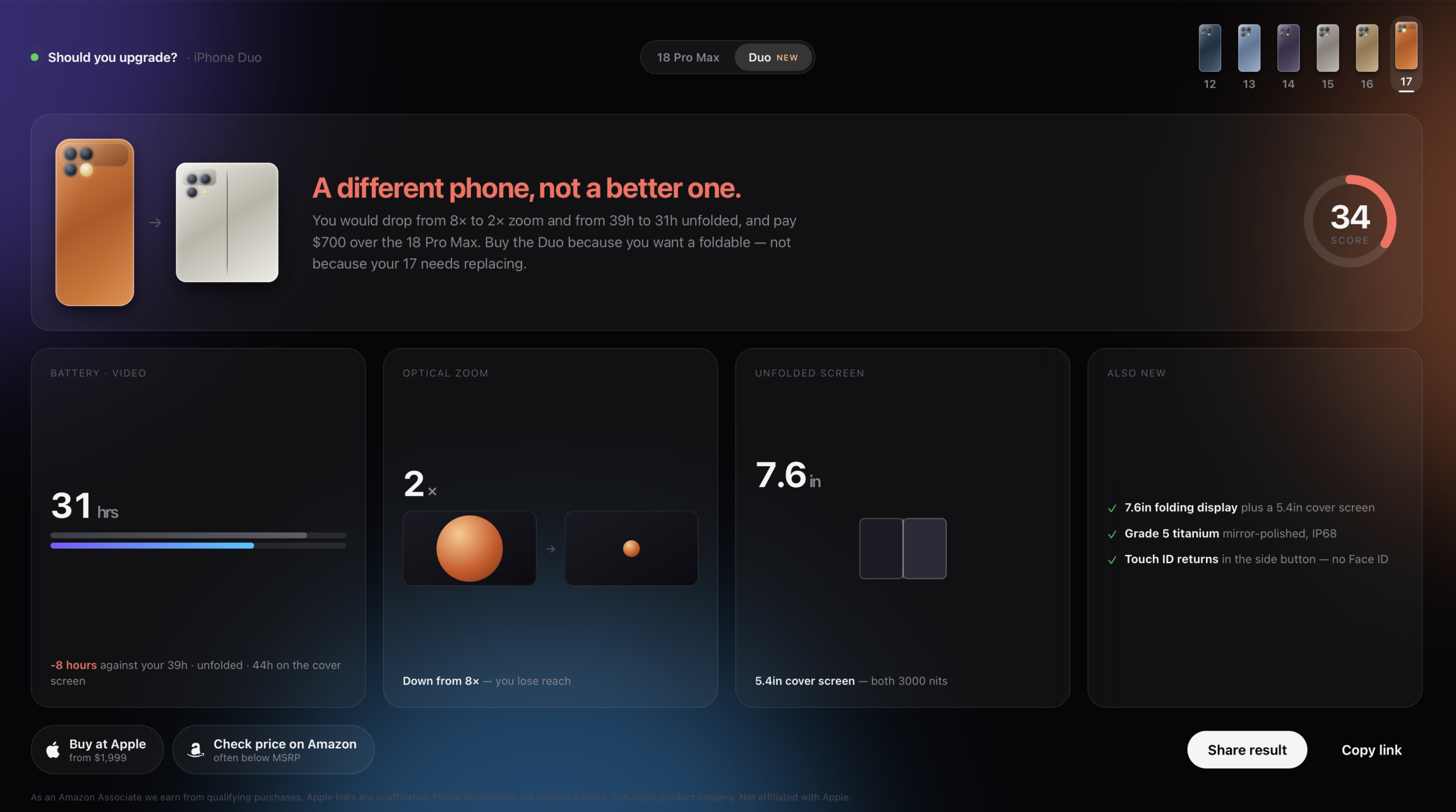
The fold is the product
Everything that makes the Duo interesting comes from the hinge. Open, it is a 7.6-inch Super Retina XDR tablet; closed, a 5.4-inch phone. Both panels hit 3000 nits and carry ProMotion, and the inner display gets a nano-texture finish to cut glare.
Three things change with the form factor, and they are the ones worth knowing before you order:
- Touch ID is back. It sits in the side button. There is no Face ID, though an Apple Watch can also unlock it.
- eSIM only. No physical SIM tray, which matters if you swap carriers or travel on local SIMs.
- A hidden front camera. Center Stage on the cover screen, plus a FaceTime camera under the inner display.
The build is Grade 5 titanium with a 3D-printed hinge cover, Ceramic Shield 2 on the front, Ceramic Shield on the back, and IP68 water and dust resistance.
The specs that matter
| iPhone Duo | iPhone 18 Pro Max | |
|---|---|---|
| Display | 7.6in inner, 5.4in cover · 3000 nits | 6.9in · 3000 nits |
| Chip | A20 Pro (2nm) · 6-core CPU, 7-core GPU | A20 Pro (2nm) · 6-core CPU, 7-core GPU |
| Main camera | 48MP Fusion | 48MP Fusion, variable ƒ/1.48–4.0 |
| Ultra wide | 48MP Fusion | 48MP Fusion |
| Zoom | 2× optical-quality | 8× optical-quality |
| Battery (video) | 31h unfolded, 44h cover screen | 45h |
| Charging | 50% in ~20 min | 50% in ~15 min |
| Build | Grade 5 titanium · IP68 | Aluminium unibody |
| SIM | eSIM only | eSIM |
| Storage | 256GB – 2TB | 256GB – 2TB |
| Colours | Star White, Night Sky | Black, Silver, Glacier, Burgundy |
| Price | From $1,999 | From $1,299 |
Duo storage runs $1,999 for 256GB, $2,199 for 512GB, $2,599 for 1TB and $3,199 for 2TB. It ships with iOS 27.1 on 23 October in the US and more than 70 other countries, and on 30 October in 28 more.
Figures from Apple’s announcement and product page; US pricing. Apple lists aperture as not applicable for the Duo and publishes no f-number for it.
Where the Duo is worse
The Duo costs $700 more than the iPhone 18 Pro Max and loses to it on three counts. Most launch coverage skips this part.
Zoom falls from 8× to 2×. The Duo has no dedicated telephoto lens. Its 2× is cropped from the main sensor, against 8× optical-quality reach on the 18 Pro Max. If you own a 15 Pro Max or newer, the Duo is a downgrade in reach — a 17 Pro Max owner gives up three quarters of it.
No variable aperture. The 18 Pro Max opens and closes from ƒ/1.48 to ƒ/4.0, the headline camera feature of this generation. The Duo does not have it, and Apple publishes no f-number for its main camera at all.
Shorter battery where it counts. 31 hours of video unfolded, against 45 on the 18 Pro Max. The 44-hour figure Apple also quotes is for the small cover screen, which is not how you will use a device bought for its big one.
None of this makes the Duo a bad phone. It makes it a different one, bought for a reason the spec sheet cannot show you.
Should you buy it?
It depends almost entirely on which iPhone is in your pocket today.
| You own | Verdict |
|---|---|
| iPhone 12 or 13 Pro Max | Strongest case. Your phone is four to six years old, and the Duo’s 2× roughly matches the reach you already have, so you lose nothing in trade. |
| iPhone 14 Pro Max | Reasonable. Everything age-related gets fixed, but you pay $700 over the 18 Pro Max and drop from 3× to 2×. |
| iPhone 15 or 16 Pro Max | Only for the fold. You give up 5× zoom and a lot of money for a screen, not a better camera. |
| iPhone 17 Pro Max | Skip it. You would lose three quarters of your zoom reach and eight hours of video, and pay $700 for the privilege. |
One more thing worth weighing: at $1,999 the Duo is roughly $100 more than the Galaxy Z Fold 8 and the Pixel 11 Pro Fold, both of which are on their later generations. First-generation hardware carries first-generation risk, and hinges are the part that has historically failed.
If you are buying, buying now is the right call — launch stock on a first-generation Apple product tends to slip into November.
Check your own phone
We built a free tool that answers this for your exact handset: iphonecomparison.pricesearchr.com
Tap the iPhone you own, then switch between the two new flagships. You get a score out of 100, a one-line verdict, and the four numbers that actually move — battery, zoom, aperture or screen size, and what else changed. It takes about three seconds and tells you to keep your phone when keeping it is the right answer.
Straight to a verdict: iPhone 15 Pro Max → Duo · iPhone 17 Pro Max → Duo · iPhone 14 Pro Max → 18 Pro Max
Specifications are from Apple’s September 2026 announcement and product pages, accurate as of publication. Some posts here contain affiliate links, and we may earn a commission from qualifying purchases at no extra cost to you. Not affiliated with Apple.